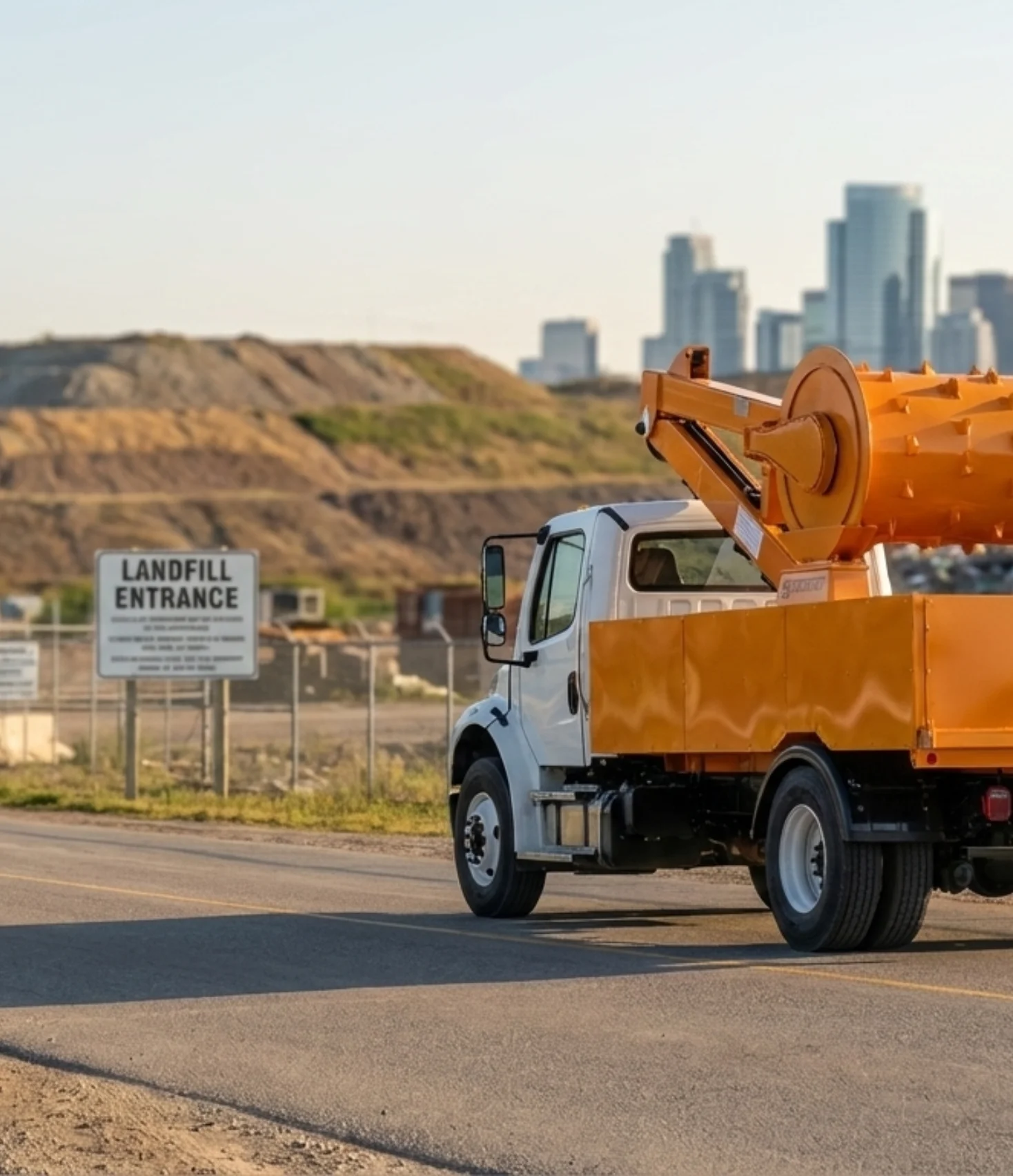
For many municipalities, landfills represent an "out of sight, out of mind" solution to the growing problem of waste. But behind the seemingly low price of tipping fees lies a complex and often overlooked web of expenses that can significantly impact municipal budgets and the environment. These "hidden costs," or externalities, include everything from long-term environmental monitoring to the social and economic consequences of land degradation. By understanding the true cost of landfills, municipal leaders can make better-informed decisions regarding their waste management strategies and explore innovative solutions that are both economically and ecologically sustainable.
Beyond Tipping Fees: Uncovering the True Cost of Landfills
The tipping fee, the price charged to bury a ton of waste, is only the tip of the iceberg when considering the true cost of this waste management method. A 2019 report by the International Monetary Fund (IMF) underscores the significant environmental and social costs associated with solid waste disposal that are often not reflected in the immediate disposal price [1]. These externalities, which represent liabilities borne by the municipality and its taxpayers, can be divided into several major areas:
1. Environmental Externalities: Pollution and Remediation Costs
Landfills are a major source of pollution with the potential to contaminate soil, water, and air for generations. The decomposition of organic waste within landfills produces leachate, a toxic liquid that can infiltrate the soil and contaminate underground water sources and aquifers. The costs associated with managing this leachate, including complex collection and treatment systems, are continuous and highly expensive. Managing leachate is a complex, continuous process that involves chemical precipitation, biological treatment (aeration and activated sludge), and sometimes reverse osmosis, adding significant, perpetual cost.
Furthermore, landfills are significant emitters of methane, a potent greenhouse gas that contributes heavily to climate change. According to a study published in the journal Science of the Total Environment, landfills represent the third-largest source of human-caused methane emissions in the United States [2]. Similarly, while capturing Landfill Gas (LFG) can offset some operational costs by converting it to Renewable Natural Gas (RNG) or electricity, the infrastructure is expensive to install, requires continuous maintenance, and is only effective for a fraction of the site's operational life. Methane leakage still occurs, often through cracks in the final cover or imperfect piping, ensuring the environmental cost persists long after the revenue opportunity fades. The ongoing costs to mitigate these environmental impacts, including the installation of synthetic liners, complex gas collection systems, and long-term monitoring and capping, can be immense and are often not fully accounted for in the initial cost of disposal.
2. Social and Economic Externalities: Impact on Community Welfare
The social and economic costs of landfills are disproportionately borne by the communities where they are located. Landfills can have a profound negative impact on local property values, with studies showing that homes located near these sites sell for significantly less than comparable properties elsewhere. They also pose tangible health risks to nearby residents, with research linking proximity to landfills to various health issues, including respiratory problems, birth defects, and general air quality degradation. Moreover, landfills can stifle local economic growth, as they often discourage new business investment, tourism, and real estate development in the surrounding area, creating zones of depressed economic activity. This economic drag diminishes the municipal tax base, requiring higher levies on other residents to maintain service levels. The legal and administrative costs associated with negotiating, litigating, and permitting new landfill space further drain municipal budgets and delay critical waste solutions.
3. Perpetual Responsibility: Post-Closure Care and Liability
Perhaps the most neglected cost is the perpetual liability associated with landfill maintenance. Even after a landfill officially closes, it continues to pose a potential threat to the environment and public health for decades, if not centuries. Municipalities are legally responsible for the long-term maintenance and management of closed sites, which includes continuous monitoring of groundwater and gas emissions, management of leachate drainage, and structural repair of the site's final cap or covering. These post-closure costs can extend for 30 to 50 years under standard regulations, and in many cases, indefinitely.
A study by the Environmental Research & Education Foundation (EREF) revealed that the typical annual post-closure care for a landfill can cost between $42,000 and $111,000 per acre per year [3]. To theoretically cover these liabilities, municipalities are required to establish financial assurance mechanisms, such as environmental trust funds, surety bonds, or letters of credit. However, many smaller or poorly managed municipal systems chronically underfund these trusts or rely on mechanisms that may not fully cover costs decades later. This creates a financial time bomb: when the funds are depleted, the remaining liability for monitoring and remediation falls directly back on the city’s general fund, paid for by current taxpayers. Furthermore, the land used for the landfill often carries perpetual land use restrictions, preventing the site from being repurposed for high-value uses like residential or commercial development, thereby permanently diminishing the community's asset base and tax potential.
Fiscal Instruments for Internalizing Landfill Externalities
As the IMF notes [1], the only way to solve the hidden cost problem is to make the tipping fee reflect the true environmental and social cost. Municipal leaders can use several fiscal instruments to internalize these costs and correct market failures, encouraging sustainable behavior:
- Landfill Surcharges and Taxes: Implementing a tax or surcharge per ton that is specifically earmarked for the post-closure trust fund or for recycling infrastructure development. This forces current disposal to pay for future remediation, avoiding the generational subsidy.
- Variable Tipping Fees: Charging significantly higher tipping fees for mixed, unsorted waste and lower or zero fees for clean, segregated recyclables or compostable materials. This market signal immediately rewards pre-sorting and diversion efforts by commercial haulers and municipal crews.
- Full-Cost Accounting (FCA): Requiring municipal finance departments to use a transparent FCA model that budgets for all known future costs, including 30 years of mandated monitoring, perpetual leachate treatment, and the opportunity cost of the land, and spreads that cost across the current waste stream. This provides the most accurate reflection of the true cost of disposal to citizens.
- Extended Producer Responsibility (EPR) Fees: Mandating that manufacturers pay a fee based on the lifecycle environmental impact of their products (especially packaging). This fee is collected and used to finance municipal recycling and diversion programs, shifting the financial burden away from the local taxpayer.
The Role of Extended Producer Responsibility (EPR) in Cost Shift
Extended Producer Responsibility (EPR) is arguably the single most powerful policy lever for transferring the burden of hidden landfill costs. EPR is a principle where the manufacturer, not the municipality or the taxpayer, is made financially and/or physically responsible for the collection, sorting, recycling, and final disposition of their post-consumer products and packaging.
In the context of landfills, EPR achieves two critical goals:
- Cost Transfer: It directly shifts the financial responsibility for managing complex and hard-to-recycle materials (which often end up in landfills, increasing methane risk and post-closure complexity) from the city budget to the industry sector. This ensures that the environmental cost of packaging is included in the product's price, rather than being externalized as a tax burden.
- Design Incentive: It creates a powerful economic incentive for producers to use less material, design for recyclability, and avoid toxic components, as cheaper-to-manage packaging results in lower EPR fees. By influencing product design upstream, EPR reduces the volume and complexity of the material stream that municipalities must handle and, subsequently, the long-term liabilities associated with landfilling those materials. This systemic shift is necessary to truly curb the perpetual costs detailed above.
The Imperative for a Circular Approach
The hidden costs of landfills clearly demonstrate that a reactive, end-of-pipe approach to waste management is fiscally irresponsible and unsustainable. The imperative is to shift focus to a proactive, circular economy model centered on reduction, reuse, and recycling. This systemic change can be achieved through various strategic investments and policy innovations:
- Investing in Modern Recycling and Composting Infrastructure: By making recycling and composting easy, efficient, and accessible for citizens and businesses, municipalities can divert a significant, valuable quantity of material from landfills. This includes adopting advanced material recovery facilities (MRFs) with automated sorting technologies and creating centralized, high-volume composting operations for organic waste.
- Implementing Policies that Mandate Waste Reduction: This can include everything from Pay-As-You-Throw (PAYT) programs which financially incentivize residents to reduce waste volume, to comprehensive bans on problematic, single-use plastics and packaging that have low recyclability and high landfill impact.
- Supporting Innovative Waste-to-Value Technologies: This ranges from advanced anaerobic digestion facilities that convert organic waste into renewable energy (biogas) to waste-to-energy (WTE) plants that thermally process non-recyclable residue into steam and electricity. These technologies recapture energy and valuable resources, fundamentally changing waste from a liability into a resource.
Conclusion: From Liability to Sustainability
The true cost of landfills is exponentially higher than the simple price of the tipping fee. By rigorously accounting for the continuous environmental, social, and perpetual post-closure liabilities associated with burial, costs that ultimately burden the taxpayer, municipalities gain the necessary impetus to redefine their waste strategy. Investing in aggressive waste diversion, sophisticated resource recovery infrastructure, and strategic operational tools like mobile compaction (which postpones the need for new landfill space) is not merely an environmental preference; it is the most fiscally responsible long-term decision a municipal government can make. By shifting focus from landfilling to circularity, cities can create a more sustainable, economically viable, and ultimately healthier future for their citizens, turning a massive financial liability into a cornerstone of sustainable development.
References
[1] International Monetary Fund. (2019). Disposal is Not Free: Fiscal Instruments to Internalize the Environmental Costs of Solid Waste. Retrieved from https://www.elibrary.imf.org/view/journals/001/2019/283/article-A001-en.xml
[2] Yaashikaa, P. R., et al. (2022). A review on landfill system for municipal solid wastes. Science of The Total Environment, 838, 156201. https://doi.org/10.1016/j.scitotenv.2022.156201
[3] Environmental Research & Education Foundation. (2024). Analyzing Municipal Solid Waste Landfill Tipping Fees. Retrieved from https://erefdn.org/analyzing-municipal-solid-waste-landfill-tipping-fees/
Easy steps to create a color palette
Lorem ipsum dolor sit amet, consectetur adipiscing elit lobortis arcu enim urna adipiscing praesent velit viverra sit semper lorem eu cursus vel hendrerit elementum morbi curabitur etiam nibh justo, lorem aliquet donec sed sit mi dignissim at ante massa mattis.
- Neque sodales ut etiam sit amet nisl purus non tellus orci ac auctor
- Adipiscing elit ut aliquam purus sit amet viverra suspendisse potent
- Mauris commodo quis imperdiet massa tincidunt nunc pulvinar
- Excepteur sint occaecat cupidatat non proident sunt in culpa qui officia
What is a color palette?
Vitae congue eu consequat ac felis placerat vestibulum lectus mauris ultrices cursus sit amet dictum sit amet justo donec enim diam porttitor lacus luctus accumsan tortor posuere praesent tristique magna sit amet purus gravida quis blandit turpis.
Don’t overspend on growth marketing without good retention rates
At risus viverra adipiscing at in tellus integer feugiat nisl pretium fusce id velit ut tortor sagittis orci a scelerisque purus semper eget at lectus urna duis convallis porta nibh venenatis cras sed felis eget neque laoreet suspendisse interdum consectetur libero id faucibus nisl donec pretium vulputate sapien nec sagittis aliquam nunc lobortis mattis aliquam faucibus purus in.
- Neque sodales ut etiam sit amet nisl purus non tellus orci ac auctor
- Adipiscing elit ut aliquam purus sit amet viverra suspendisse potenti
- Mauris commodo quis imperdiet massa tincidunt nunc pulvinar
- Adipiscing elit ut aliquam purus sit amet viverra suspendisse potenti
What’s the ideal customer retention rate?
Nisi quis eleifend quam adipiscing vitae aliquet bibendum enim facilisis gravida neque euismod in pellentesque massa placerat volutpat lacus laoreet non curabitur gravida odio aenean sed adipiscing diam donec adipiscing tristique risus amet est placerat in egestas erat.
“Lorem ipsum dolor sit amet consectetur adipiscing elit, sed do eiusmod tempor incididunt ut labore et dolore magna aliqua enim ad minim veniam.”
Next steps to increase your customer retention
Eget lorem dolor sed viverra ipsum nunc aliquet bibendum felis donec et odio pellentesque diam volutpat commodo sed egestas aliquam sem fringilla ut morbi tincidunt augue interdum velit euismod eu tincidunt tortor aliquam nulla facilisi aenean sed adipiscing diam donec adipiscing ut lectus arcu bibendum at varius vel pharetra nibh venenatis cras sed felis eget.

Antoine Galdès
For over 10 years, I’ve worked in marketing with a strong focus on cleantech innovation and the evolving challenges shaping the waste and compaction industry. I’m passionate about staying ahead of industry trends, continuously learning, and sharing practical insights that help businesses and municipalities improve their operations more efficiently and sustainably.
.webp)
